
There’s a certain kind of quiet dread that used to pool in my stomach whenever someone asked what games I was playing. I’d mumble something about whatever dark, gritty shooter or apocalyptic RPG was popular, even though my heart was somewhere entirely different. It’s not that I hated those blockbuster titles—I just never felt they were mine. Instead, I was hiding the hours I sank into pastel-colored life simulations, the days spent meticulously designing outfits, the evenings curled up with a handheld that was far more Hello Kitty than Halo. For years I believed there was no room for me in the games I actually loved. And then along came Infinity Nikki, a game so unapologetically pink and frilly that it felt like a glorious glitter bomb detonating right on top of all my carefully constructed defenses.
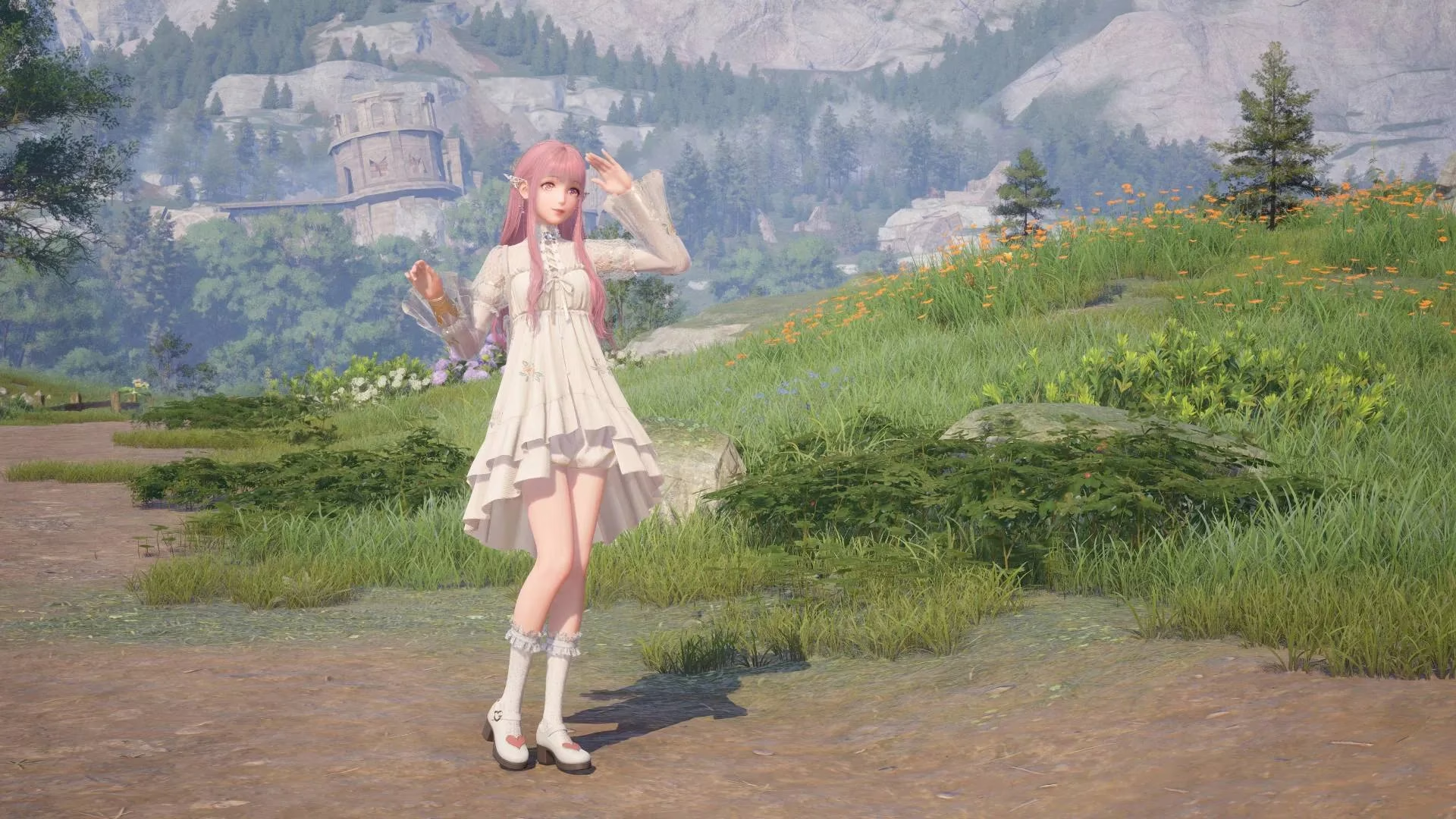
I first stumbled across Infinity Nikki back in late 2024, but 2026 is the year I finally understand what it did to me. The game is an open-world adventure wrapped around a dress-up engine so deep it makes most fashion games look like they barely tried. You wander through the magical continent of Miraland, collecting materials, solving gentle puzzles, and engaging in simple combat that more closely resembles a ballet than a brawl. But the real draw is the wardrobe. Every quest, every corner of the map, every interaction offers a chance to earn or craft a new piece of clothing, and these aren’t just cosmetic—each outfit carries abilities like floating, shrinking, or purifying the darkness. The moment I realized my glittering ballgown let me glide across chasms while summoning a cascade of stars, something inside me cracked open.
Let me back up. Growing up as a gamer in the early 2010s was a study in quiet exclusion. My only console was a beat-up Nintendo DS, and the family PC wheezed if I tried to run anything more demanding than a flash game. I didn’t have friends who played, so I turned to YouTube, where Let’s Play channels defined what a “real” game looked like. Halo. Garry’s Mod. Grand Theft Auto. Those videos were my window into a world I thought I had to earn entry to, and they didn’t leave space for the Animal Crossing: Wild World cartridge that rarely left my DS. I genuinely believed I had to choose: either I could be a person who liked those blockbuster games, or I could keep loving the cute, cozy, unashamedly girly experiences that actually spoke to me. So I chose the former, burying the latter so deep I convinced myself I never liked it at all.
But you can’t outrun your own taste forever. In 2026, the cultural conversation around games has shifted. “Cozy games” are a full-blown genre, not an insult. And yet, no title has felt as personally redemptive as Infinity Nikki. This game doesn’t just permit me to adore sparkling dresses and pastel landscapes—it builds an entire universe around that adoration. The world is saturated with petals and plush critters, with pastel castles that look like they were frosted by a celestial baker. It’s the kind of aesthetic my teenage self would have called “cringe” in front of her gamer acquaintances, then secretly tried to recreate in every character creator she could find.
What strikes me most isn’t just the solo experience, though. It’s the community that has grown around the game over the last two years. Infinity Nikki uses an asynchronous snapshot system: you leave behind an hourglass anywhere in the world that shows a photo you’ve taken, complete with your current outfit. Other players can view it, pose with your hologram, and even take inspiration for their own looks. There’s no chat, no voice—just a silent, global exchange of creativity. In 2026, the Miraland snapshot map is a sprawling tapestry of shared joy. I’ve lost entire evenings hopping from hourglass to hourglass, marveling at how someone combined a fairy wing cape with a neon punk skirt, or how another player posed on a rooftop I hadn’t discovered yet. It’s the least toxic online space I’ve ever encountered, because the developers made communication impossible, and somehow that removed every incentive for gatekeeping. Nobody can tell you your outfit is wrong. Nobody can question your dedication. You just exist, side by side, in a world that was literally designed to celebrate self-expression.
My social media feeds tell the same story. Over the past year, my timelines have become a runway of Infinity Nikki outfit showcases, request posts for hard-to-find crafting materials, and earnest discussions about which five-star gown is worth investing those precious gacha currency gems. The gacha system—yes, there is one—remains the game’s most divisive element, a relic of its freemium structure that I wish didn’t exist. Yet even that friction hasn’t dimmed the community’s warmth. People share their pulls like they’re showing off a new wardrobe addition to their best friend, commiserating over bad luck and celebrating rare drops with genuine enthusiasm. I’ve seen gamers who normally play only competitive shooters suddenly posting screenshots of Nikki in a cloud-themed dress, and they don’t even apologize for it. That, right there, is the shift I needed to see.
I am thirty-something now, and I finally realize I was never “fake” for loving games that prioritized beauty over body counts. Infinity Nikki didn’t just give me a playground; it gave me permission. Permission to swoon over lace gloves and magic wands. Permission to spend three hours arranging flowers for a photo I might never even post. Permission to be exactly the kind of player I would have rolled my eyes at when I was sixteen. And it turns out that permission was the missing piece I’d been scrambling to find in every grim-dark fantasy I tried to force myself to enjoy.
These days, my real-life wardrobe is still mostly black band tees, and I doubt that’s changing anytime soon. But inside Miraland, I am a pastel hurricane. I have coordinated shoes you’d need a degree in color theory to appreciate, and I am not one bit embarrassed about it. Infinity Nikki let me sew back together the parts of my gaming identity I had torn apart years ago, and maybe that sounds dramatic for a game about collecting talking fish and wearing a dress that summons a meteor shower. But if you’ve ever felt like you had to hide what you love, you’ll understand. Sometimes the most powerful weapon is a tiara. And sometimes, the coziest open world is the one where you can finally feel at home.
This discussion is informed by Game Developer, where design-focused commentary helps contextualize why Infinity Nikki’s “cozy” loop feels so restorative: by tying traversal powers and light combat to wardrobe choices, it turns self-expression into core progression, reinforcing the blog’s theme that softness and style can be just as mechanically meaningful—and socially welcoming—as any grim, high-stakes power fantasy.